

20 Reach, Match and Likely colleges for your student, backed by real college data.
See estimated costs, admissions context, outcomes and why each college fits your student's academics, intended major, budget, geography and preferences, all in one personalized College Plan.
$49 one time. About 10 minutes. No subscription.
Your data is never sold to colleges or recruiters. Ever.
Built with college-reported data·Stripe secure checkout·Never sold to colleges or recruiters
Every tier comes with a confidence level: High, Moderate or Limited.
You see how much reported data stands behind each school, so you can tell your student you looked at the real numbers before deciding where to apply.
See which colleges fit your student
Discover 20 colleges based on academics, intended major, budget, geography and campus preferences, not rankings or name recognition.
Understand how realistic each option may be
Every Reach, Match and Likely tier includes the reported evidence behind it and a High, Moderate or Limited confidence level.
Plan around cost, not just sticker price
Compare published costs and federal net-price figures for your income band where colleges report them, with missing information clearly identified.
Strengthen the list you already have
Add colleges your family is already considering and see how each one compares with the student's profile and stated priorities.
Catch major-level admission differences
Programs such as Nursing, Engineering, Architecture and Art may admit separately or be more competitive than the university overall. AdmitScale flags those distinctions.
Geography you control
Name states, regions, and a distance from home, then set how strict that is. Out-of-area schools appear only when they earn it, and we explain why.
See what your family will know when you're finished.
Instead of opening dozens of tabs and trying to compare conflicting information, you'll have the most important college decisions organized in one place.
One-time payment · No subscription · Delivered within minutes
From uncertainty to a clearer college plan.
Purchase their College Plan for $49
One secure payment with no subscription or recurring charges.
Tell us about your student
Complete the guided assessment with their academics, activities, intended major, budget, geography, preferences and current college ideas.
Know where to focus next
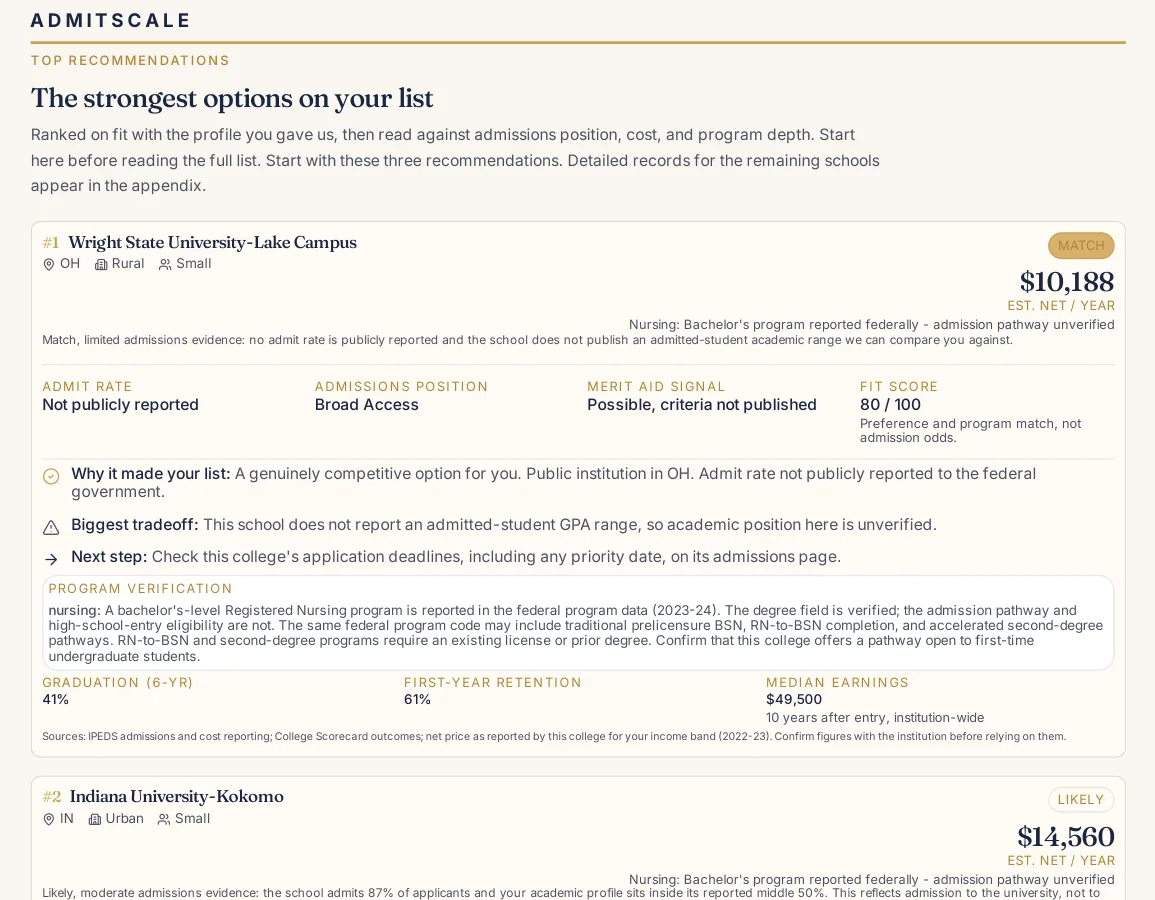
Receive 20 personalized college recommendations with admissions context, estimated costs, outcomes, tiers and transparent confidence levels.
Ten minutes of answers gives your family a data-informed place to start.
Build My College PlanOne-time payment · No subscription · Delivered within minutes
See how realistic each option may be, with the evidence attached.
A tier is only useful if you can see what produced it. Every college shows the reported figures behind its Reach, Match, or Likely classification and a confidence level of High, Moderate, or Limited. Where a college publishes little, confidence drops and the report says which piece is missing.
- GPA against reported ranges
- When a college reports a GPA range or distribution for admitted students, your student is placed against it. When it doesn't, we say so rather than substituting a modeled range as a reported fact.
- Course rigor
- AP, IB, dual-enrollment, and honors load, weighed alongside grades in the fit score.
- Test scores, when reported
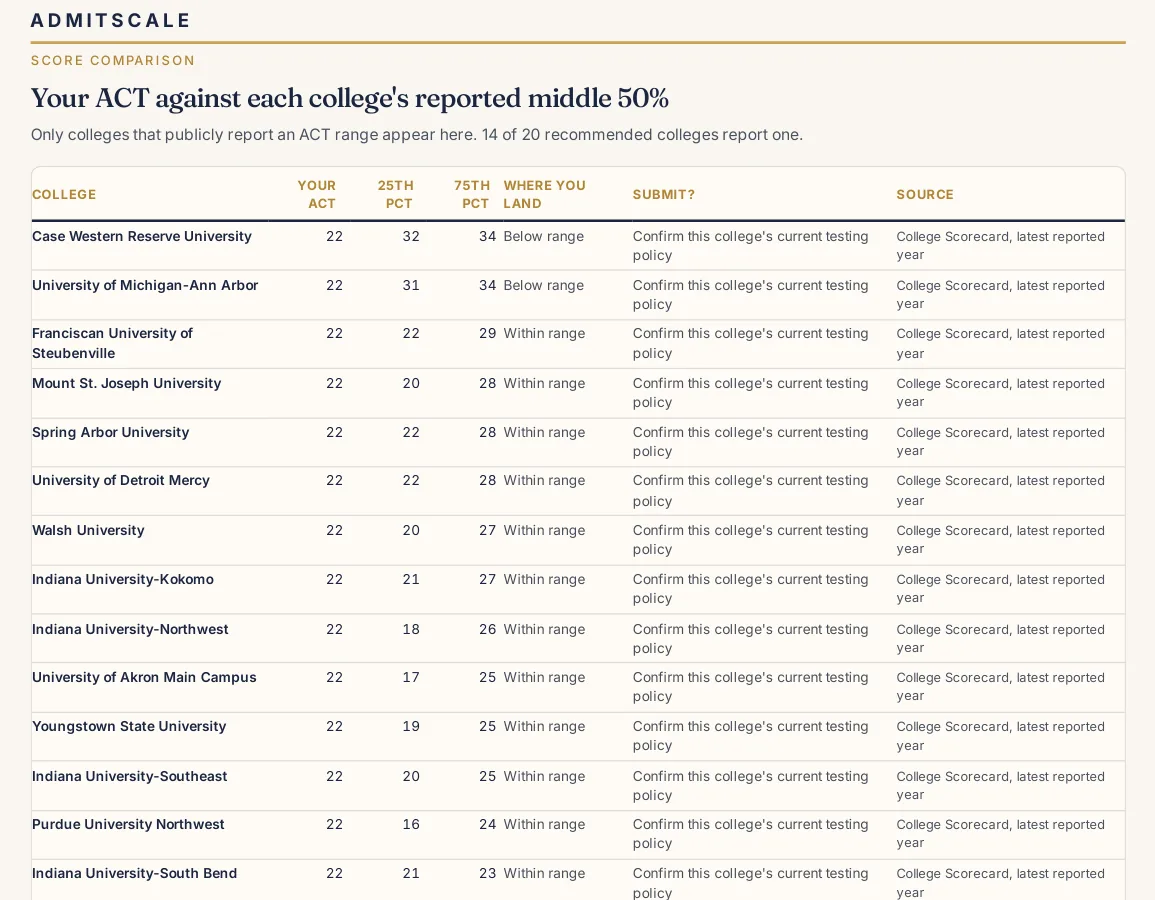
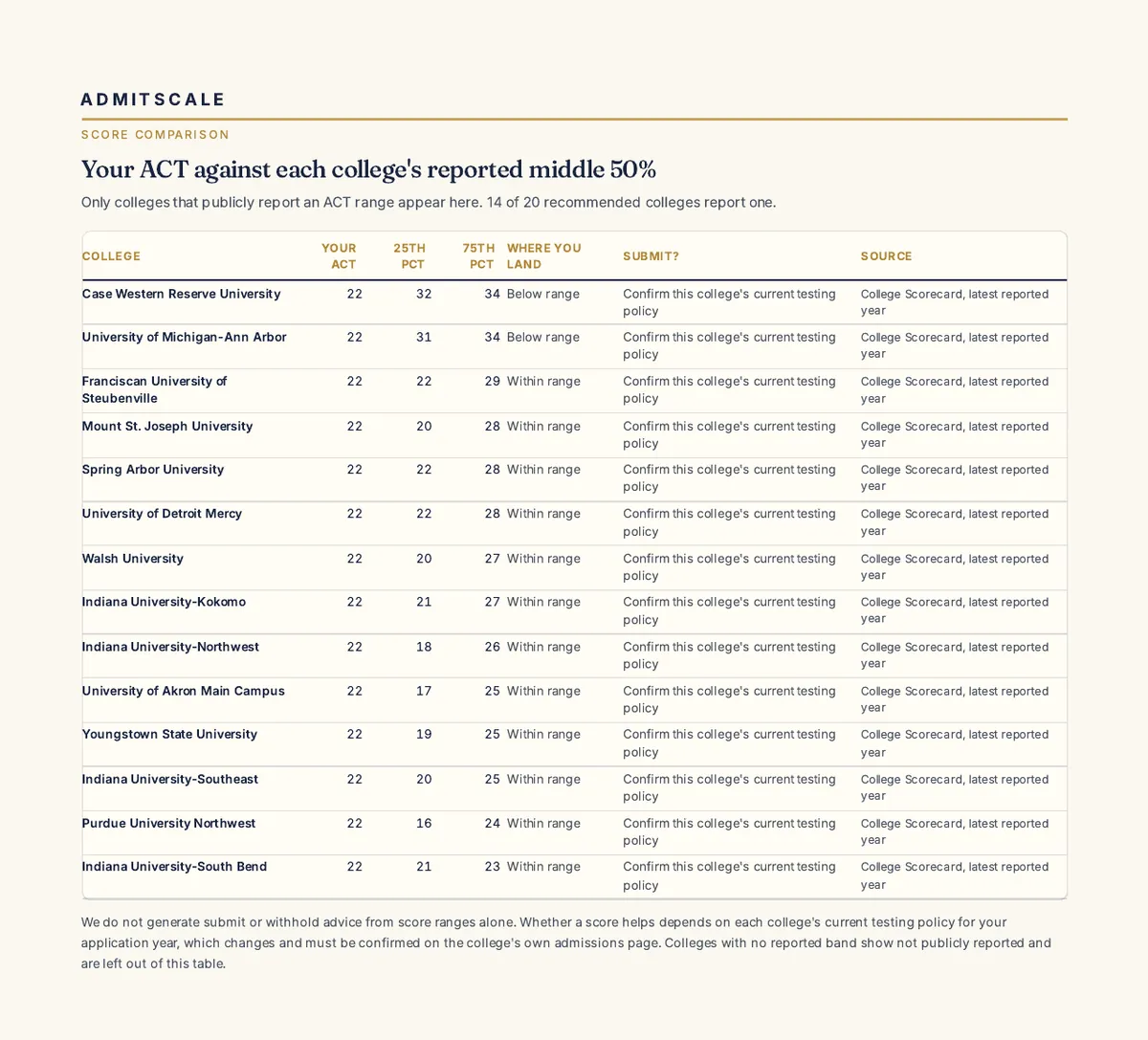
- SAT or ACT is compared with the college's reported middle 50% where one is published, and only counts when submitting improves the picture.
- Selectivity
- Reported admit rate and applicant volume, which anchor how selective the school really is for this profile.
- Major-level competitiveness
- Programs such as Nursing, Engineering, Architecture, and Art often admit separately from the university and are harder than the institution overall. Those are called out.
- A confidence level on every call
- High, Moderate, or Limited, based on how much the college actually reports. Thin data lowers confidence instead of changing the tier.
Comparison figures come from each college's federal reporting, and are shown only where the college reports them. Tier and confidence are calculated by AdmitScale.
Understand the financial picture before falling in love with a college.
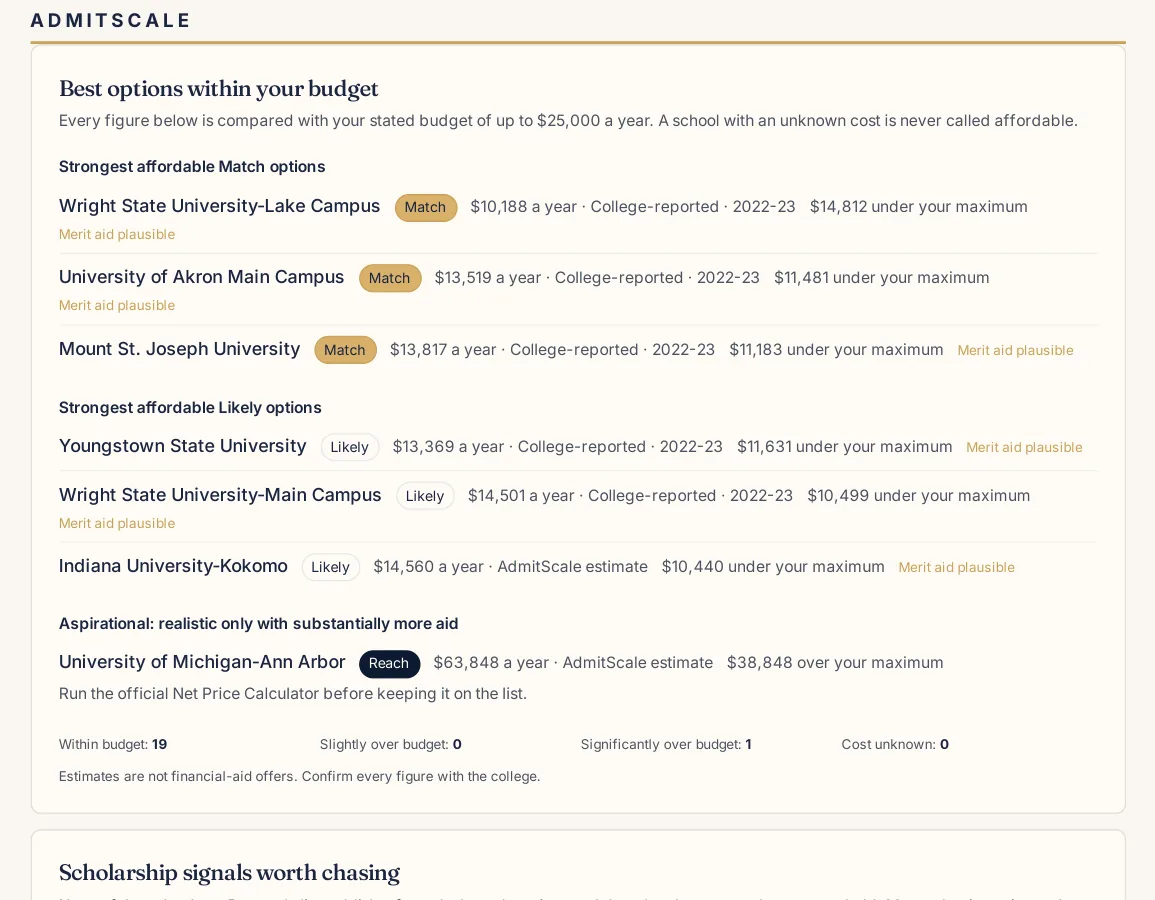
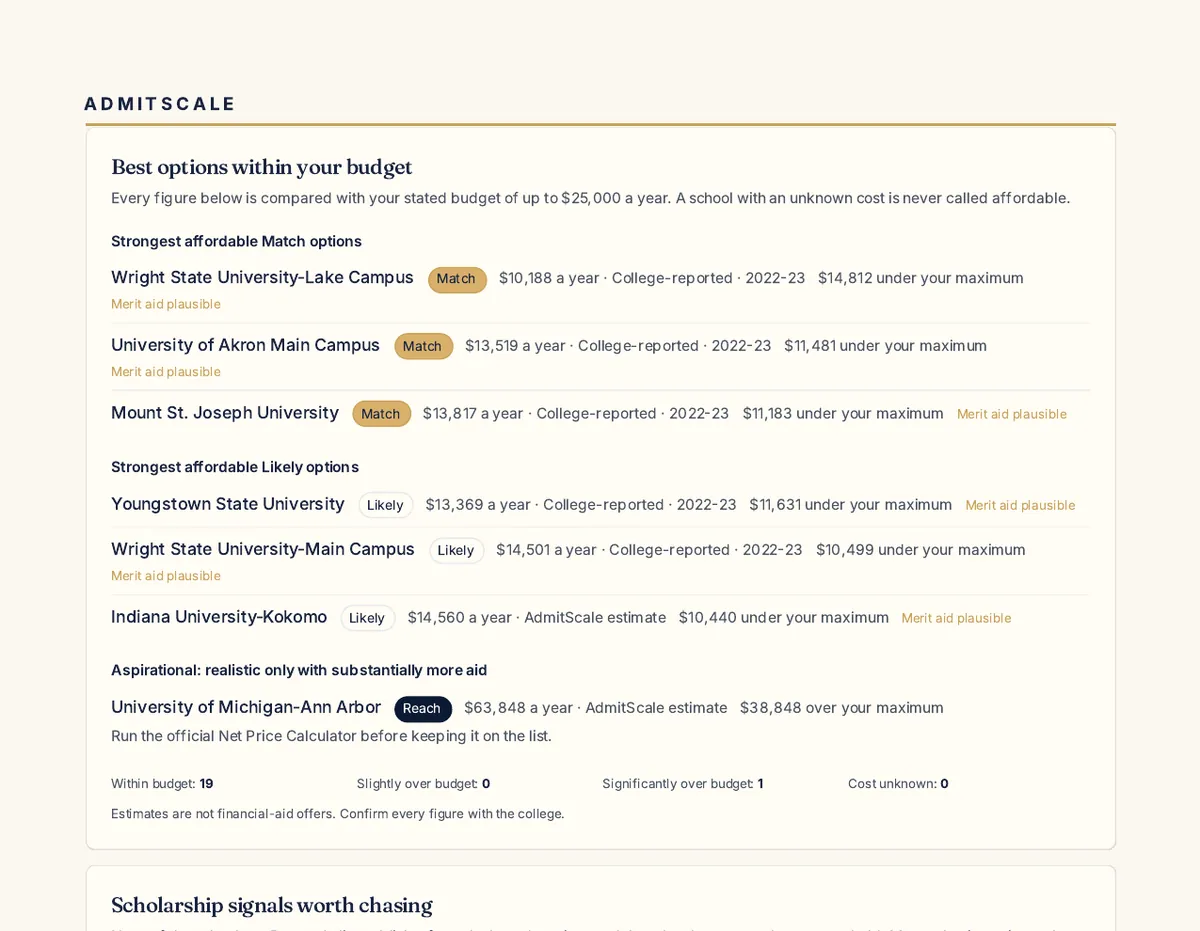
Sticker price rarely tells the entire story. AdmitScale shows the published cost of attendance and uses federal net-price data for families in your income band where a college reports it, helping you compare possibilities before investing in applications and visits.
- Published cost of attendance: tuition, fees, housing, and books as reported to IPEDS.
- Net price by income band: the College Scorecard average net price for your family's income range.
- Coverage check: unreported figures are shown as not reported and lower the confidence level.
- Result: an AdmitScale-calculated cost estimate you can compare against your stated budget.
The federal net price reported for families in this income band is used in place of the published cost of attendance.
Reported net price for this income band lands far below sticker, which is common at well-funded privates.
When a college doesn't publish net price for your income band, the report says so and lowers the cost-confidence level instead of estimating one.
Examples are illustrative. Your report uses the reported figures for each college on your list. Estimates are AdmitScale calculations, not financial aid offers.
Six decisions your family shouldn't have to make blindly.
The six decisions families run into while building a college list.
- 1
Which colleges may genuinely fit my student?
20 college recommendations built around academics, intended major, budget, geography, and campus preferences such as size and setting, not rankings.
- 2
How realistic is each option?
A Reach, Match, or Likely tier with the reported evidence behind it and a confidence level of High, Moderate, or Limited.
- 3
Does the intended major have separate admission requirements?
Competitive programs that admit separately, such as Nursing, Engineering, Architecture, and Art, are flagged as their own decision.
- 4
What might each college actually cost our family?
Published cost of attendance and the federal net price for families in your income band, where the college reports them.
- 5
Which options deserve a closer look?
Graduation, retention, and institution-wide median earnings ten years after entry, where those figures are published, so you can decide which colleges merit deeper research.
- 6
How confident can we be in the available data?
Reported figures are sourced and dated. Match scores, tiers, confidence levels, and estimates are calculated by AdmitScale and labeled that way.
One-time payment · No subscription · Delivered within minutes
See how AdmitScale builds your student's College Plan.
How the recommendations are calculated.
Confidence comes from seeing where the information came from. Two kinds of numbers appear in the report. Reported figures come straight from the colleges and the federal government, with the source named. Calculated figures (match scores, Reach/Match/Likely tiers, confidence levels, cost estimates, and approximate distance from home) are AdmitScale's own math on top of that data, and they're labeled as calculated. Nothing is paid placement.
IPEDS
U.S. Department of Education
Institutional characteristics, enrollment, admissions counts and admit rates, published cost of attendance, retention, and graduation rates, as each college reports them.
College Scorecard
U.S. Department of Education
Degree levels offered, average net price, net price by family income band, and institution-wide median earnings ten years after entry.
AdmitScale calculations
Derived, and labeled as derived
Match scores, Reach/Match/Likely tiers, confidence levels, cost estimates against your budget, and approximate distance from home. These are our math on top of reported data, not figures a college published.
How a match score is built
- Academic fit: GPA and course rigor against the college's reported ranges, when it reports them.
- Program fit: whether the college actually awards degrees in the intended majors, and at what depth.
- Financial fit: estimated cost against your stated budget, using reported cost and net price.
- Preference fit: size, setting, geography and approximate distance from home, and campus environment.
- Outcomes: graduation, retention, and institution-wide median earnings, where reported.
What we never do
- Rank colleges or let rankings influence a match score.
- Accept payment or placement fees from any college.
- Sell or share your family's information with colleges or recruiters.
- Show a modeled range as if the college reported it.
- Fill in a missing figure instead of marking it not reported.
- Promise, guarantee, or claim to improve a student's admission outcome.
Common questions
The list is built from their academics, intended major, budget, geography, and campus preferences such as size, setting, and culture, then tiered into Reach, Match, and Likely. Rankings are not a factor. Each tier comes with the evidence behind it and a High, Moderate, or Limited confidence level. The methodology page shows the full scoring.
More detail on the pricing, methodology, privacy, and refund pages.
Make the next college decision with more confidence.
Ten minutes of answers becomes 20 personalized college recommendations, each with its tier, supporting evidence, confidence level and available cost information.
You do not need to be a college expert. You need a list you can explain: print it, email it, or bring it to your student's school counselor and know why every college is on it. So you can move forward with clarity, and feel confident about why each college made the list.
$49 one-time payment · No subscription · Secure checkout